
In Texas Hold’em, the two cards dealt to you do not automatically belong in your final hand. You compare the best five-card combination available under the rules, even when that means using only one private card or neither. Recognizing a pair, straight, or flush is part of the job. You also need to establish which cards form the combination being compared.
Hand rankings alone do not explain which cards you can use. In his 2025 discussion of player reference cards, Justin Bell describes how the card game The Gang separates reminders about poker hand rankings from reminders about round structure. Knowing where a flush sits in a ranking does not, by itself, explain how to assemble a hand.
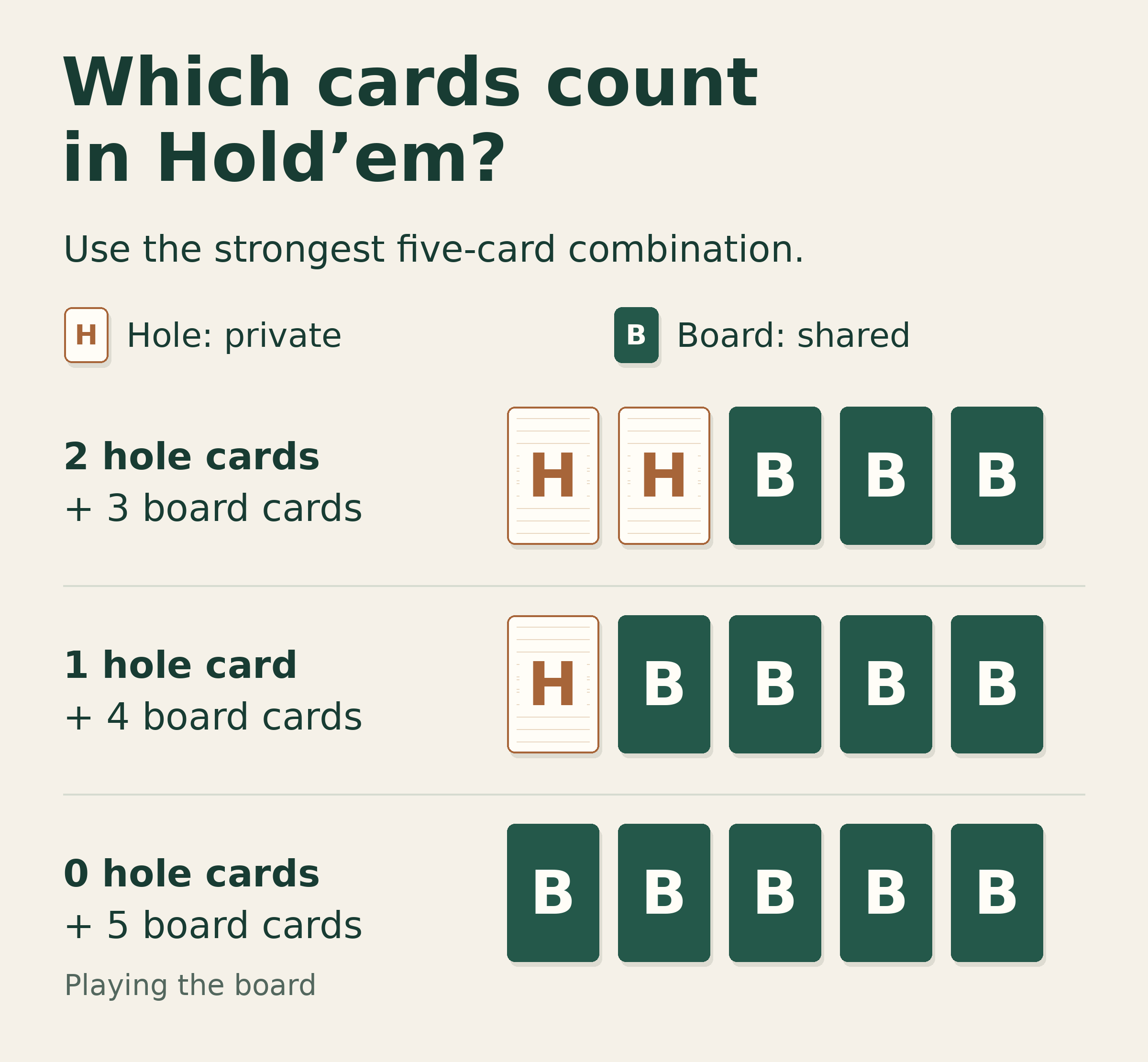
Image Source: Infographic by author
Start with the cards you can use
Hold’em gives each player two private cards, called hole cards. Up to five community cards appear in the middle of the table: three on the flop, one on the turn, and one on the river. Together, those shared cards are called the board. Every player still involved can use them; one player using a community card does not stop another from using it.
When you compare Hold’em hands in online poker, include a private card only when it belongs to your strongest five-card combination. The permitted choices are two hole cards with three board cards, one hole card with four board cards, or all five board cards. There is no requirement to preserve your original pair or give a private ace special treatment.
The selection can change as the board develops. A card that helped form your strongest combination earlier may become unnecessary after another community card appears. At the final comparison, use the strongest permitted hand now available, rather than the combination you saw early on.
Keep completed combinations separate from draws. Four cards of one suit are not a flush, and four consecutive ranks are not a straight. Those patterns may describe what another card could complete, but they do not receive the completed hand's ranking. At showdown, when hands are compared after the final betting round, use what the available cards actually make; cards that never appeared cannot fill a missing place in the hand.
Compare the combination before its supporting cards
First, identify the hand category. Under standard high-hand rankings, a full house ranks above a flush, which ranks above a straight. A higher category takes precedence over the individual ranks in a lower category. An ace does not make a pair outrank three of a kind.
When categories match, compare the cards that define them. With pairs, compare the paired ranks first. With two pairs, compare the higher pair, then the lower pair. With full houses, compare the three matching cards before the pair. This order prevents an impressive-looking spare card from displacing the combination itself.
A kicker is an unpaired card within the five-card hand that can settle an otherwise equal comparison. One pair leaves room for three kickers. Compare those from highest to lowest, stopping at the first difference. Two pairs leave room for only one kicker, so a sixth card cannot become an extra decider.
Straights and flushes already occupy all five places. Compare straights by their highest card; an ace used below the 2 makes a five-high straight. Compare flushes from their highest card downward until a difference appears. Neither hand has room for an additional kicker outside its five cards.
A shared board can produce a genuine tie
Using the board is often called “playing the board.” If those five cards make the strongest hand available to each remaining player, the players have equal hands. However, a strong board alone does not establish a tie: a private card might improve one player's best combination.
When the best five-card hands are equal in rank, suits do not break the tie in standard Hold’em. Hearts do not outrank clubs, and an unused private card does not rescue the comparison. There is no search for a sixth or seventh card once the five that count are equal.
Keep the game name beside the ranking chart
Other community-card games impose different construction rules. In standard Omaha, a player must use exactly two hole cards and three board cards. The freedom to use the whole board in Hold’em therefore cannot be carried across simply because both games display shared cards.
Short Deck poker appears in profiles of Canadian poker players, including the entries for Daniel Dvoress and Michael Watson. Watson’s entry describes both No-Limit Hold’em and Short Deck appearances. Following the same player across those formats requires checking the game being discussed. A familiar combination can occupy a different position in the ranking when the deck changes.
Christopher Williamson's 2025 mathematical preprint on poker hand rankings examines how changing a deck changes the relative frequencies of combinations. In the Short Deck version described there, the 2s through 5s are removed and a flush ranks above a full house. That reverses their standard Hold’em order. Other reduced-deck games can use different rankings, so their rules need checking separately.
Before comparing hands, establish the variant, identify the cards it permits you to use, and form each player's strongest permitted combination. Then apply that game's ranking and tie-breaking rules. Once the five-card hands are equal, any unused cards cannot change the result.