
Original illustration created by author specifically for this article
One card game can feel different from another without changing its deck or main objective. Move one rule, and the player’s attention moves with it. Hidden cards create suspense. Open cards create planning. A stricter draw rule creates pressure. A wider set of playable choices creates room to experiment.
That is the quiet design lesson behind card game rule variations. A useful way to frame it comes from research on the core mechanic of games, which describes gameplay as a repeated pattern of player action and game response. In card games, that pattern may be drawing, revealing, matching, building, holding, or choosing when to stop. Variations work because they adjust that repeated action, not because they replace the game’s identity. Small rules often leave the clearest trace in actual play.
When One Rule Changes the Feel of the Game
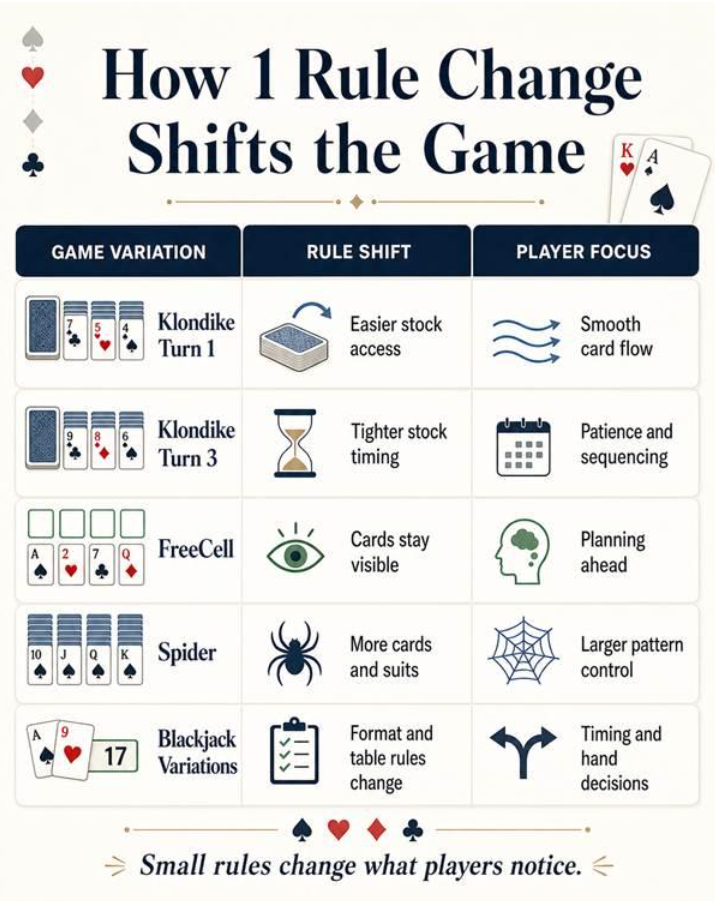
Image source: Original graphic created by author specifically for this article
ALT text: Card game rule comparison table
Solitaire variants help us understand this. Klondike asks players to uncover hidden cards and build foundations. FreeCell keeps nearly everything visible, so the challenge becomes planning, rather than discovery. Spider stretches the puzzle across a larger field, while Pyramid and TriPeaks shift attention toward pairing and sequence.
Blackjack shows the same principle from another classic card game angle: the central aim remains getting close to 21 without going over, but surrounding details can change the pace and feel of each hand. To see that idea in a modern blackjack category, online crypto blackjack gives a direct reference point because the page presents crypto blackjack games, supported digital coins, and multiple named versions built around the same 21-based objective.
The point is that a stable rule center can support many play textures. A classic format may feel measured, a multi-hand format may feel more active, and a live dealer format may feel more social in rhythm. Once that design idea is clear, online crypto blackjack becomes a useful comparison for how small format changes can preserve the game’s recognizable core while changing what the player notices.
A short introduction video continues the same old-to-new thread. It connects pixel-era gaming memories with plain blockchain education through virtual coins, retro consoles, and digital ownership. That matters here because card game variations often work the same way. They keep something recognizable in view, then change the surrounding system enough to make the experience feel fresh
Solitaire Variations Show Design in Plain Sight
Solitaire reveals design clearly because it removes conversation, bluffing, and table politics. The puzzle sits in front of the player. Every rule change shows up as a change in attention.
|
Rule change |
What it changes |
How it feels to the player |
|
Turn 1 draw |
Stock access loosens |
More continuous |
|
Face-up FreeCell cards |
Information becomes visible |
More strategic |
|
Multiple Spider suits |
Sequence building grows harder |
Broader |
|
Pyramid pairing |
Matching replaces foundations |
Faster |
These examples show why “more rules” is not always “better design.” A strong variation usually has one clear pressure point. Turn 3 Klondike does not need to change the goal. It simply changes when useful cards appear. FreeCell does not need suspense from hidden cards. It creates interest by asking whether the visible board can be untangled cleanly. Spider does not need a new deck identity. It builds depth through scale.
Blackjack Variations Make the Pattern Easier to Read
Blackjack is useful because its core can be understood quickly, and that clarity makes variation easier to notice. If the dealer rule changes, the texture changes. If more than 1 hand is played, attention splits. If the format includes a live dealer, the round has a different tempo from a fully digital version.
This is why blackjack can be simple to learn while still being interesting to compare across formats. The key design question is not “how many versions exist?” It is “what does this version make the player notice?” A version can emphasize pace, visibility, decision timing, or table atmosphere while leaving the recognizable 21-based frame intact.
The same is true across classic card games. A small rule change can alter:
- What the player sees first
- How much uncertainty remains
- When a decision feels urgent
- Whether the game rewards planning, reaction, or patience
That is why variations endure. They give familiar games fresh angles without asking readers to relearn everything.
Why Familiar Games Keep Evolving
The strongest card game variations respect memory. They give the player a known start, then adjust the pressure around it. Too much change, and the game feels unrelated. Too little change, and the variation feels unnecessary.
That balance helps explain why classic card games keep moving across tables, browsers, phones, and newer digital settings. People return because the rules feel understandable, then stay curious because the details keep shifting. A familiar game can ask a new question simply by changing what is hidden, what is visible, what can be replayed, or how many decisions happen at once.
Tiny rule changes reveal what a card game is truly made of. They show where tension lives, where memory helps, and where the next decision becomes interesting. The deck can stay the same for decades while the experience keeps evolving, a pattern also reflected in open-access research on video game nostalgia and retro gaming.