

Three wins in a row can feel meaningful. So can a sudden cluster of blocked moves, favorable cards, or strong plays from an opponent. Yet a streak should affect the next decision only when something in the game has actually changed. The useful question is not whether the run looks impressive. Ask whether it altered the information available, created a new constraint, or revealed a pattern with a plausible effect on what happens next.
Random sequences rarely look as tidy as people expect. A fair process can produce clumps, repetitions, and long runs without developing memory. Research on random sequence generation describes sequential independence as a condition in which one choice has no bearing on later choices. The same study found that people’s attempts to produce randomness changed according to the instructions they received, which helps explain why intuition is a poor judge of what a random pattern should resemble.
Testing a Momentum Claim in Real Time
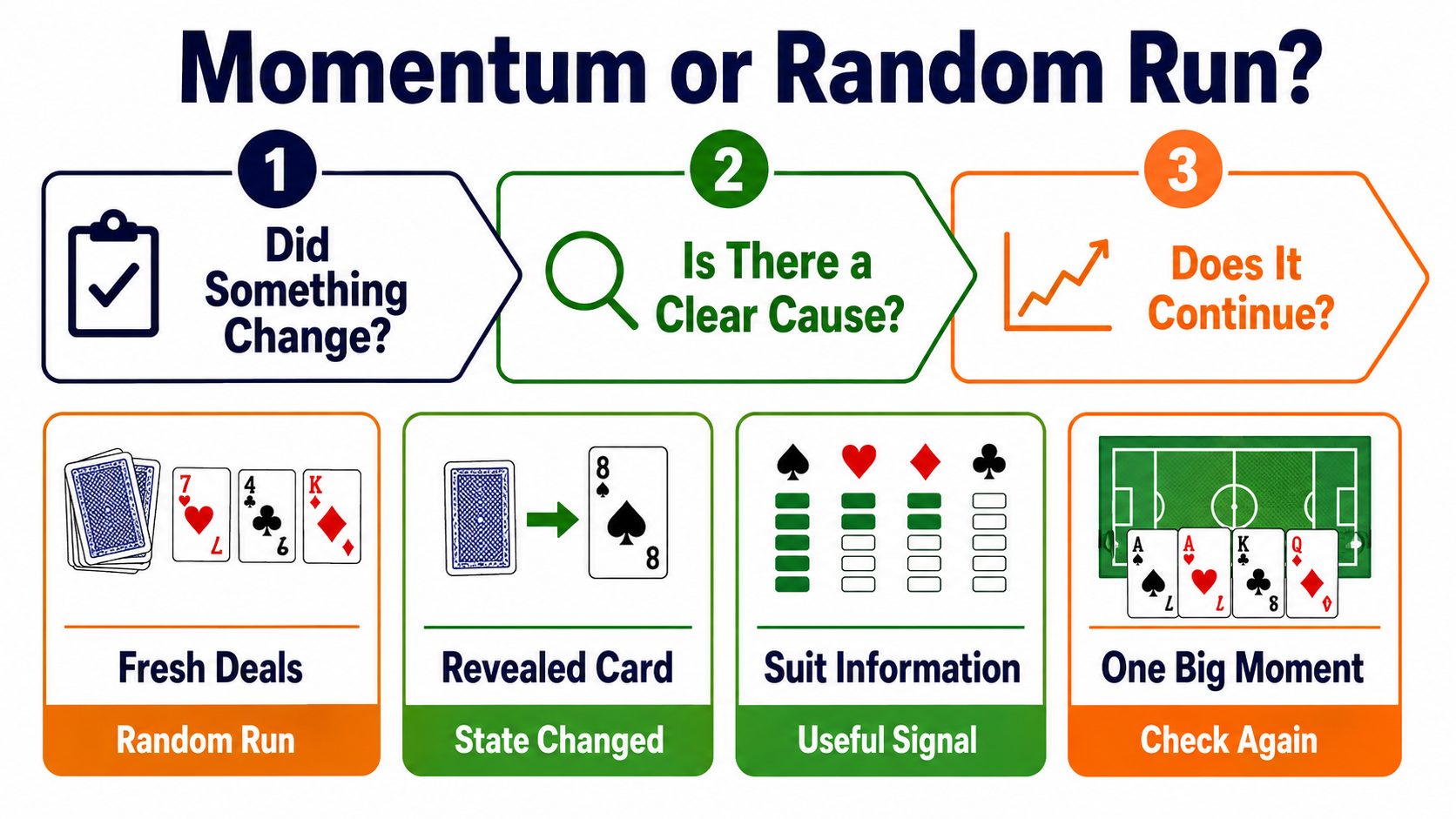
Image source: Infographic by the author
Recent events deserve attention when they change the state of play. Recency alone is weak evidence. A useful test asks what changed, what could connect that change to the next decision, and whether the effect remains visible after one dramatic moment.
That distinction becomes clearer in formats where information arrives continuously. Lucky Rebel is a sportsbook and casino homepage that presents sports alongside casino games, including blackjack among its visible favorites. In that setting, a score, injury, lineup change, exposed card, or sequence of choices may alter what the player can observe, but the latest result still needs interpretation.
Start with change: did the event reveal information or remove an option? Then examine the cause: is there a credible mechanism connecting it to the next phase? Finally, test persistence: does the condition continue, or did attention settle on one striking outcome? Looking at Lucky Rebel through those questions keeps the emphasis on the game state rather than the excitement of the sequence. The test does not promise certainty; it simply separates observable conditions from narrative. A run matters when it changes the next decision through identifiable conditions. Without that link, it remains a run.
A companion discussion of momentum in live sports offers examples such as shot quality, turnovers, foul trouble, pass protection, and injuries. These are useful illustrations because each can be tested for an underlying change. A scoring burst by itself says less than repeated access to open shots, while one pressured play says less than a defensive line winning the same matchup repeatedly.
The Change, Cause, Persistence Test
The same method works across solo card games, trick-taking games, and live competition.
|
Situation |
Change |
Cause |
Persistence |
|
Three wins across freshly shuffled Solitaire deals |
No continuing game state |
No mechanism connects the deals |
The streak is historical |
|
A face-down card is exposed in Klondike |
New card information becomes available |
It opens or blocks specific moves |
The effect lasts while the layout remains |
|
Several hearts appear early in Hearts |
Suit information has changed |
Remaining cards and player choices are easier to estimate |
The signal strengthens as more cards are played |
|
A key player leaves a live game |
Personnel and matchups change |
Roles, coverage, or pace may shift |
Check whether play remains different afterward |
The table prevents a common mistake: treating every sequence as either pure luck or genuine momentum. Some runs contain no new information. Others reveal a structural change, even when they do not guarantee what comes next.
When the Previous Hand Really Matters
A new Solitaire deal normally starts with a new shuffle, so the previous win or loss does not alter the card order. It can still affect the player. Confidence may speed up decisions, frustration may narrow attention, and a remembered pattern may be applied where it does not fit. That is carryover in judgment, not momentum in the deck.
Within one deal, the answer changes. Exposing a card in Klondike changes the available moves. In Hearts or Spades, every card played updates what can remain in each suit and may reveal how an opponent is approaching the hand. These events have change and cause. Their persistence depends on whether the information remains relevant as play continues.
This distinction also stops players from dismissing every streak as meaningless. If an opponent repeatedly avoids a suit, the pattern may reflect the cards already shown. If a sequence of blocked Solitaire moves traces back to one irreversible choice, the later failures share a cause. The run has diagnostic value because the same condition continues to shape the game.
Keep the Pattern in Its Proper Place
Recent experience can influence the observer, even when it does not alter the underlying process. A 2025 PLOS Biology study on serial dependence during decision-making examined visual working-memory tasks and found that prior stimuli could bias later recall and decisions. It did not study card games, but it helps explain why the last hand can feel unusually important.
Before allowing a streak to guide the next move, separate the game from the player’s memory of it. Identify a real change, name the mechanism, and check whether the condition persists. When those steps fail, the sequence may still be memorable, but it has not earned a role in the next decision. That boundary is the heart of the method.